
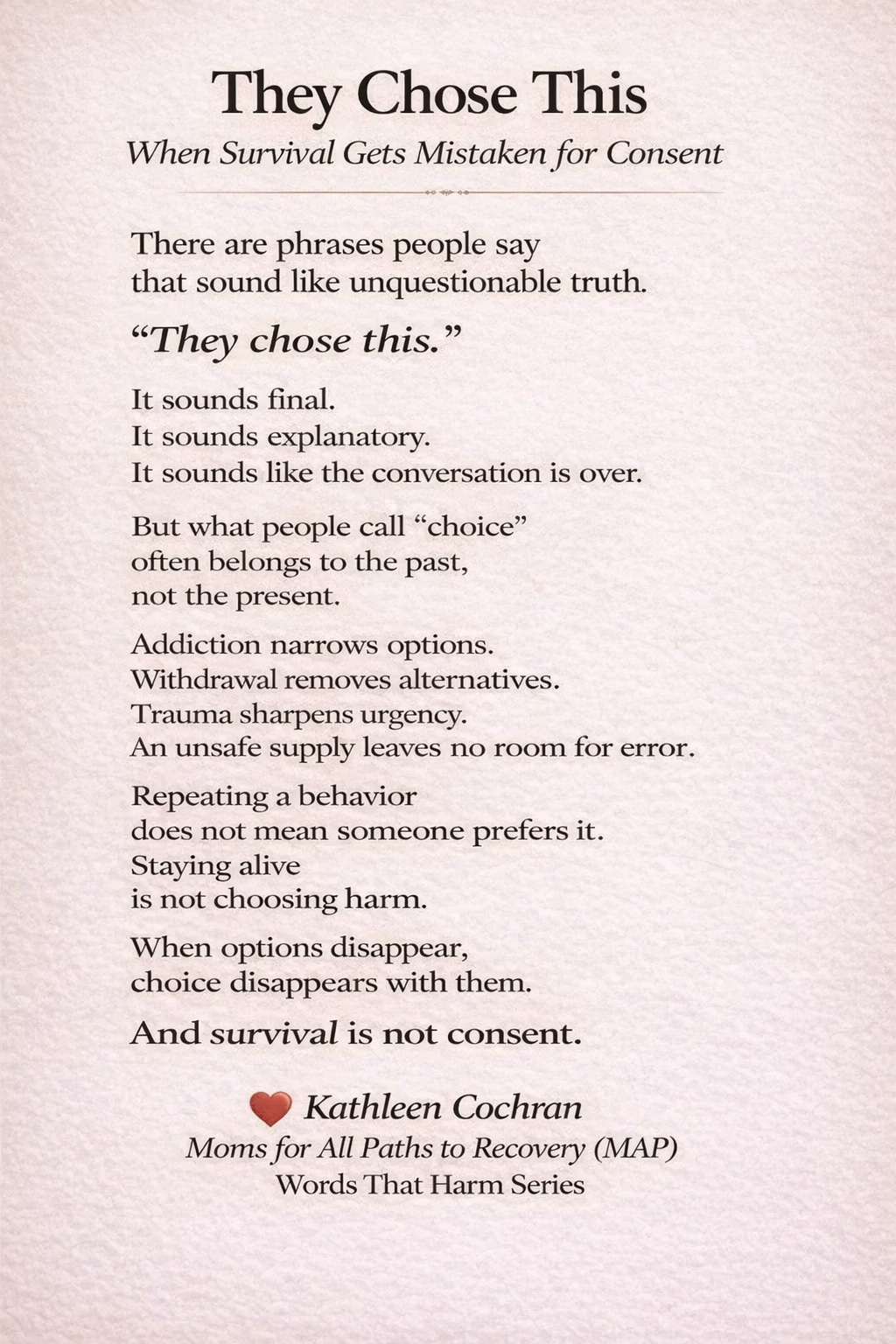
They Chose This
When Survival Gets Mistaken for Consent

There are certain sentences people say with such confidence that they sound like fact.
“They chose this.”
It’s usually said casually.
With a shrug.
As if it explains everything.
As if the conversation is over.
And maybe, early on, there was a choice.
The first time.
The second.
Even the third.
But addiction doesn’t stay where it starts.
And choice doesn’t survive what comes next.
When people say, “They chose this,” I want to ask a different question.
What do you think they were choosing?
They weren’t choosing chaos.
They weren’t choosing withdrawal.
They weren’t choosing a poisoned supply or a future shaped by loss.
They were choosing relief.
Quiet.
Sleep.
Numbness.
Confidence.
A pause from sadness that felt too heavy to carry.
They were choosing less pain.
Relief doesn’t mean harmless.
It means necessary in that moment.
When I try to explain addiction, I often say this:
mothers give up their children.
Who does that?
Not people chasing pleasure.
Not people making casual decisions.
People who are starving.
Literally starving.
Addiction doesn’t feel like desire.
It feels like hunger.
The kind of hunger that will do whatever it has to do to survive.
Once addiction takes hold, the landscape changes.
Choice narrows.
Biology enters the room.
So do fear and survival.
Withdrawal removes alternatives.
Trauma sharpens urgency.
An unsafe supply leaves no margin for error.
Poverty, instability, and isolation close doors long before anyone calls it a decision.
What people point to as “choice” is often a memory, not a present reality.
And past choice is not the same thing as present consent.
Repeating a behavior doesn’t mean someone prefers it.
Persisting doesn’t mean they want the consequences.
Staying alive is not the same as choosing harm.
Still, this phrase gets used.
To justify distance.
To ease discomfort.
To shift responsibility away from broken systems and onto the person struggling, and onto the parents who love them.
Parents aren’t ignoring reality.
They’re responding to it.
They see the narrowing.
They see the fear.
They see how options disappear long before judgment arrives.
Understanding this doesn’t excuse harm.
It doesn’t deny accountability.
It doesn’t pretend addiction isn’t destructive.
“They chose this” sounds simple.
But when options disappear, choice disappears with them.
And survival is not consent.
Don’t forget to follow us on X @momsallpaths, and if you aren’t already a member, join the Facebook group at https://www.facebook.com/groups/momsforallpath
Thank you. Always always Truth be Told. ❤️